

Mastering our Housing Destiny: A breakdown of the 2026 Federal Budget
November 10, 2026
Kenneth Milner
On November 5, the federal government tabled Budget 2026, titled “Masters of Our Destiny.” There is a lot to unpack for community housing and homelessness, so here is my best shot at explaining it.
Start with the headline promises. The government says this budget will:
- Triple the rate of non-market (community) housing development over the next 10 years, reaching 24,000 new homes a year.
- End homelessness within 10 years.
Both are admirable goals. Let’s look at how the government plans to get there, and then at what is still missing.
The New National Housing Direction
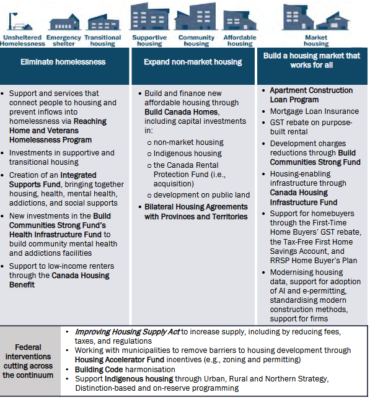
Every housing investment in Budget 2026 sits under one of three pillars (Image 1). Each pillar maps to a part of the housing continuum (Image 2), which gives us real clarity on how the government is thinking about the National Housing Strategy. Pillars 1 and 2 matter most to our sector, so let’s focus on those.

Pillar 1: Eliminating Homelessness
- Reaching Home and the Veterans Homelessness Program extended. $6.5 billion over 10 years, starting in 2027-2028. This increases funding for both programs and, most importantly, avoids the fiscal cliff expected in 2028.
- New money for supportive and transitional housing. $10 billion over 10 years, starting in 2027-2028, delivered through Build Canada Homes (BCH). It covers capital costs only. The government expects provinces and territories to fund operations and wraparound supports.
- A renewed Canada Housing Benefit. $5.6 billion over 10 years, to be matched by provinces and territories. It shows the federal government is still committed to rent subsidies.
- More funding for support services. The new Integrated Supports Fund receives $5 billion over 10 years, and the Health Services Infrastructure Fund (first announced in Budget 2025) gets an additional $2 billion over two years. Both provide capital for new support services. The Integrated Supports Fund will run through BCH and aims to bring housing and supports together. The Health Services Infrastructure Fund will stay with Innovation, Science and Economic Development Canada. Neither builds housing directly, but more support services are vital to ending homelessness.
Pillar 2: Expanding non-market housing
- Recapitalizing Build Canada Homes. BCH receives an additional $13 billion over 10 years, starting in 2028-2029, to build non-market housing. This is on top of its funding for supportive and transitional housing and the Integrated Supports Fund. At least 10% will go to Indigenous housing projects through a distinctions-based formula.
- Federal lands. BCH also receives $2 billion to prepare federal lands for housing, funding water, wastewater, roads, and other enabling infrastructure. Expect this to expand its direct builds program.
Federal, Provincial, and Territorial Agreements (FPT Agreements)
The government plans to announce new federal, provincial, and territorial (FPT) agreements in the next Spring Economic Statement. These must bring new federal commitments and require provinces and territories to bring their own. That matters for filling gaps like operating funding and wraparound supports for supportive housing. These agreements should also reveal provincial and territorial contributions to the jointly funded Canada Housing Benefit.
Looking Forward
We can now see how this government thinks about housing and what its National Housing Strategy will look like. Our job is to make sure it closes the remaining gaps.
- An URN Indigenous housing plan. We need a well-resourced, for-Indigenous, by-Indigenous plan for distinctions-inclusive urban, rural, and northern housing. The government has shown it can make 10-year commitments, so we need one here.
- A real housing delivery system. The government has framed its approach this way, and we must hold it to that. This means funding capacity-building through proven partners like the Community Housing Transformation Centre (CHTC) and the National Indigenous Housing Collaborative Inc. (NICHI).
- Renewal and repair. There is still no funding or financing to renew and repair existing non-market housing. The most affordable housing is the stock we already have. Preserving and revitalizing it, and strengthening the organizations that own it, is critical.
- Pre-development funding. To build a long-term pipeline of projects, the federal government also needs to invest money into getting projects off the ground.
Finally, a word on the scale and ambition of this budget. Tripling non-market starts and building 200,000 new homes is a major step forward, but it falls short of CHRA’s goal of doubling the share of non-market housing. As our report I’ll Have a Double-double, Please: Quantifying the base to scale up non-market housing in Canada outlines, that would take an additional 750,000 units. We get there by running with this commitment, delivering quickly, holding the government accountable, and pushing for more.
I believe we can do it, and I think our sector is ready for the work.